
- This event has passed.
LC3 Day in Ha Noi, Viet Nam
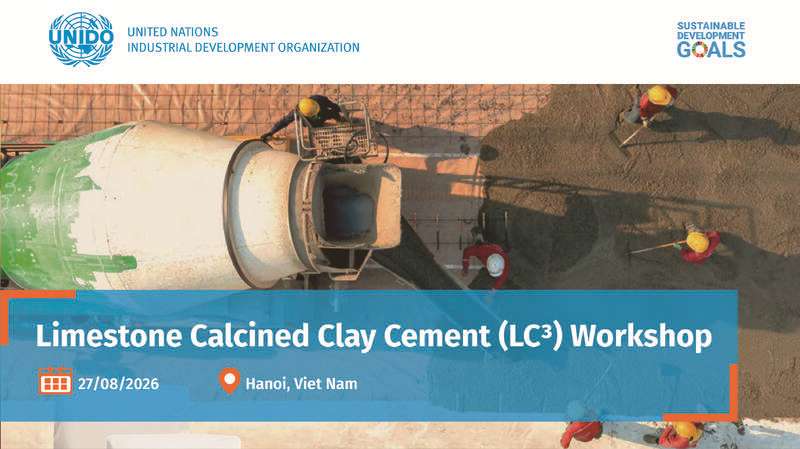
Advancing Practical Pathways for Low-Carbon Cement
Cement and concrete are essential to Viet Nam’s continued development, infrastructure expansion and urban growth. At the same time, cement production is one of the country’s most carbon-intensive industries. As the world’s third-largest cement producer, Viet Nam’s cement sector accounts for approximately 16% of national greenhouse gas emissions, making its decarbonization critical not only to the country’s climate commitments, but also to the long-term competitiveness of its industry.
The transition is already underway. Viet Nam is advancing new policy, financing and technological pathways to support the decarbonization of its cement sector, while industry and research institutions are increasingly exploring practical solutions to reduce clinker use and lower the carbon intensity of cement production.
One of these solutions is Limestone Calcined Clay Cement (LC3). By replacing a significant share of clinker with calcined clay and limestone, LC3 can reduce CO₂ emissions by up to 40% compared with conventional Portland cement, while maintaining comparable performance and durability. Importantly, the technology can be integrated into existing cement infrastructure with relatively limited additional investment, offering a practical and scalable pathway for countries with established cement industries such as Viet Nam.
On 27 August 2026, stakeholders from across Viet Nam’s cement and construction value chain will come together in Ha Noi for the LC3 Day Workshop. The event is jointly organized by the United Nations Industrial Development Organization (UNIDO), the Viet Nam Institute for Building Materials (VIBM), the Low Carbon Construction Association (LCCA), the Embassy of Switzerland in Viet Nam and the Viet Nam National Cement Association (VNCA).
Bringing together government representatives, researchers, cement producers, industry leaders and development partners, the workshop will provide a platform to exchange knowledge and explore practical pathways for accelerating the adoption of low-carbon cement technologies in Viet Nam.
Discussions will focus on the potential of LC3 within the Vietnamese context, including technology and production, raw materials, standards and market acceptance, as well as the broader policy and financing conditions needed to support industrial-scale deployment.
As Viet Nam moves towards its net-zero commitment for 2050 and strengthens efforts to decarbonize its heavy industries, LC3 offers an opportunity to reduce emissions today using technologies and resources that can be deployed at scale.
LC3 Day Viet Nam 2026 aims to bring together the knowledge, experience and partnerships needed to turn this opportunity into practical action.